Dirk Braeckman: Although




GRIMM is pleased to present Although, a solo exhibition by Dirk Braeckman, on view at the London gallery from April 23 to May 30, 2026. Bringing together a focused selection of recent works, the exhibition situates these within the broader arc of Braeckman’s practice and marks the artist’s first solo presentation in the United Kingdom.
For over four decades, Dirk Braeckman has developed a distinctive and influential body of work rooted in the materials and processes of analogue photography, favouring experiential techniques that resist traditional photographic conventions. Within his practice, the darkroom emerges as both a site of discovery and spectral agent in the making of images. With a shared affinity for exposing their means of production, his works charts the material processes of photography itself as well as the imprints of time.
The exhibition title, Although, emerges from ongoing conversations around Braeckman’s images and the continual questioning of what is visible and what remains obscured. Drawing from a fascination with the history and technical processes of photography, Braeckman’s works reflect on images today and how we consume them. The works featured in this exhibition foreground this relationship, drawing attention to the material qualities and imperfections of the photographic image.
Working from a vast archive of negatives, Braeckman’s images often feature dissonant landscapes, architectural motifs and obscured subjects clipped from their original settings. In L.J.-L.S.-22, a female sitter is shown looking away from the camera. Looking at the back of her soft veil of hair and the angle of her shoulder, they differ from the conventional portrait format, in which the sitter faces the lens and establishes a direct connection with the viewer. By having the sitter turn her face or body away, Braeckman moves away from a traditional portrait and instead opens the image to a more ambiguous, vernacular interpretation.
Drawn to the unintentional aesthetic qualities contained in vernacular photography, Braeckman’s fascination with images produced outside the sphere of art, often for practical or documentary purposes, continues to inform his works. These include anonymous product photographs, private snapshots, legal records, and scientific imagery. Like many vernacular images, his works often depict quiet interiors, ambiguous spaces, or scenes perforated by the indelible markers of absence.
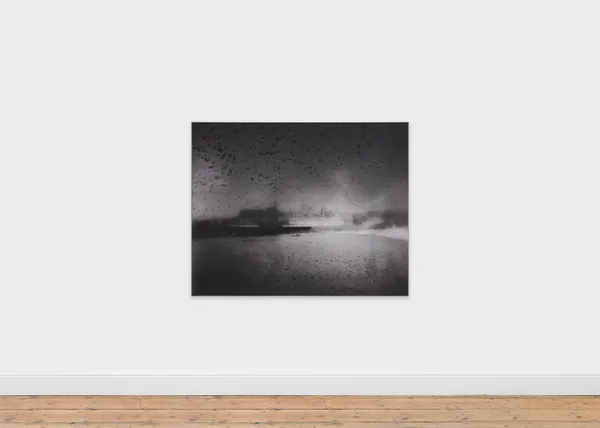
In ECHTZEIT#117-24, created for his museum show Echtzeit at FOMU, Antwerp (BE), in 2024, Braeckman selected images from the museum’s collection to work with. A ship is depicted half-concealed in grainy darkness against the backdrop of a frothing ocean, a silvery and subdued presence floating eerily, merging into the smokey recesses of the frame. Half blackened by process, Braeckman’s images possess an alchemical complexity to them, collaging and re-photographing these reproductions, he adds dust and paint, smearing images before processing, lending them to an ambiguous and inscrutable quality. Imperfections such as scratches, creases, dull spots or subtle shifts of light are not concealed but highlighted as integral elements of the composition. Through this process, Braeckman positions the photograph not simply as a visual representation but a physical object – something that carries with it the traces of process, time and touch.
Process continues to intercept form in much of Braeckman’s photographic oeuvre, in Dear deer , As soon as, an image of a figure is half-veiled by the distressed surface, marred by sensitive cracking and the reflective mark of a flash. The figure, seemingly unidentifiable, appears to be stood against a wooded backdrop punctuated by a gaping flash. Braeckman’s counterintuitive format charges his images with mysterious otherness and a mechanical intricacy that recalls the ideas of Roland Barthes, who in Camera Lucida (1980) describes a photographic punctum as the unexpected detail in a photograph that pierces the viewer and provokes an emotional response. Many of the images Braeckman works with are anonymous, detached from a clear author or context.
As Italian philosopher Umberto Eco observed of certain works of art, their openness lies in their ability to generate questions rather than fixed meanings. Braeckman’s photographs operate precisely in this way: they withhold certainty while inviting contemplation. With their haunting stillness and ashen, moody dispositions, Braeckman’s images appear suspended outside place and narrative. Instead of offering a contemplative, nostalgic lens on the world as many would assume, they point to a compelling preoccupation with what photography can tell us – as opposed to what we think it shows us – about time. Within Braeckman’s works, the act of looking is reframed; viewers encounter photography not as a transparent window onto the world, but as a material form – one that unfolds through process, memory, and interpretation.
Braeckman has recently completed a major site-specific commission for Brussels Zaventem Airport (BE), titled Elongation. The two-part installation comprises two 90-metre-long friezes, totalling 180 metres, and will be unveiled soon.
